Article 6 of the Constitution defines that Islam is Morocco’s
“State Religion” and guarantees freedom worship for all.
The great majority of Moroccans are Muslims.
The country is organized around its Sovereign, who is both
its spiritual and temporal leader. Islam is the source of the
King’s legitimacy, the theoretical foundation of His power
and the supreme reference of a legitimate structure that
allows the Sovereign to proclaim His preeminence. As
stated in article 19 of the Constitution the King, “Amir Al Mumineen” (Commander of the Faithful) shall be the Supreme Representative of the Nation and the Symbol of the unity thereof. He shall be the Defender of the Faith and the Protector of the rights and liberties of the citizens, social groups and organisations.
The reigning Alawite Dynasty has ruled the country
since 1640; King Mohammed VI is a direct descendent
of the Prophet Sidna Muhamad (Peace be upon Him).
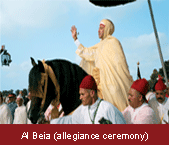
A contractual element - The Beia - legally binds the
King and the community; the latter pledges allegiance
to the Sovereign, while He - the “Commander of the
Faithful” - acts as the Defender of the Unity of the State
and of Religion, according to the Achaari Doctrine and
the Malikite Rite. Islamic Law validates this ritual as a
foundation of the powers of the Amir.
The title of Amir Al Mumineen, “Commander of
the Faithful”, has been reaffirmed by the Moroccan
Constitution; it relates to the religious role of the
Sovereign and distinguishes Morocco from other Muslim
nations.
The Beia is an act of allegiance whereby the companions
of the Prophet owed him faithfulness. In Morocco, the
Beia is a confidence pact and mutual commitment
whereby, in the name of people, the Ulemas (scholars)
recognize the new Sovereign and grant Him the power
to rule, protect and impose the respect of the precepts
of Islam, to see to the security of the peoples and to the
unity of the State.
Islam as practiced in Morocco is better understood as
a continuation of the Andalusian Golden Age that
witnessed the peaceful coexistence and intellectually
fruitful cooperation of the three monotheistic religions.
This cross-fertilization has generated a unique brand of
Moroccan Islam and has influenced all aspects of the
country’s, civilization and culture.