The foods of Morocco take great advantage of
the natural bounty of a country where eating is both a practical
and social ritual. The cooks in the kitchens of the four royal
cities (Fez, Meknes, Marrakech and Rabat) helped to refine Moroccan
cuisine and create the basis for what we know as Moroccan cuisine
today. The midday meal is the main meal, except during the holy
month of Ramadan, and abundant servings are the norm. The meal
usually begins with a series of hot and cold salads which are
followed by a tagine, or stew. The heartiest plate, often a
lamb or chicken dish, is next, followed by a heaping plate of
couscous topped with meats and vegetables. A soothing cup of
sweet mint tea is the grace note to this repast. It is not uncommon
for Moroccans to eat using the first three fingers of a hand,
and to use bread as a "utensil." 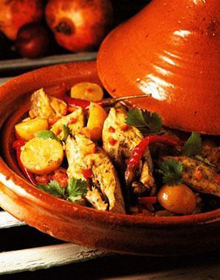
The strong Arab influence found
in two of the royal cities, Fez and Marrakech, contributed
greatly to Moroccan cuisine, as did the Andalusian sensibilities
of Tetuan and the Jewish traditions from the coastal city
of Essaouira. Aspects of all of these cultures can be found
in four of the best-loved Moroccan dishes: couscous, plumped
semolina grains which are served with a variety of toppings;
bisteeya, a delectable three-layer pie which is both savory
and sweet and wrapped in the thinnest of pastry; mechoui,
tender roasted lamb; and djej emshmel, succulent roasted chicken
cooked with olives and lemon.
While spices have been imported to Morocco for thousands of
years, many commonly-used raw ingredients are home-grown:
mint and olives from Meknes, oranges and lemons from sunny
Fez, prickly pear from Casablanca and shad from the Sebou
river. Also cultivated in Morocco are pomegranates, almonds,
dates, walnuts, chestnuts, honey, barley, cherries and melon.
Seafood is abundant along the Atlantic coast while lamb and
poultry are raised on higher ground.
The Moroccans are quick to point out that the best meals
are found not in the restaurants but in the homes. In this
land of good and abundant food, the emphasis is clearly on
preparing your own. It is worth mentioning that women do virtually
all of the cooking in this very traditional country.
For Further Informations
Please Visit:
http://www.sallys-place.com/
|
For Further Informations
Please Visit:
http://www.cuisinedumaroc.com
|
|
 Home
Home


 Society and Culture
