British Museum (London): When Sir Hans Sloane died in 1753,
he bequeathed to England his vast collection of art and antiquities
for only £20,000 ($34,000). This formed the nucleus
of the collection that would one day embrace everything from
the Rosetta stone to the hotly contested Elgin marbles (Greece
wants them back). It's all here -- and much more -- in one
of the world's great museums.
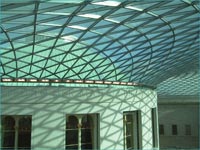 National
Gallery (London): One of the world's greatest collections
of Western art dazzles the eye. Every artist from da Vinci
to Rembrandt to Picasso is represented here. The gallery is
especially rich in works by Renaissance artists. National
Gallery (London): One of the world's greatest collections
of Western art dazzles the eye. Every artist from da Vinci
to Rembrandt to Picasso is represented here. The gallery is
especially rich in works by Renaissance artists.
Tate Britain (London): Two great national collections --
some 10,000 works -- call this gallery home. Sir Henry Tate,
a sugar producer, started the nucleus of the collection with
only 70 or so paintings. But the Tate has grown and was considerably
enlarged when J. M. W. Turner bequeathed some 300 paintings
and 19,000 watercolors to England on his death.
National Gallery of Scotland (Edinburgh): This museum boasts
a small but choice collection whose presence in Edinburgh
is firmly entwined with the city's self-image as Scotland's
cultural capital (Glaswegians will happily dispute that idea).
Highlights include works by Velázquez, Zurbarán,
Verrocchio, del Sarto, and Cézanne.
National Museum of Scotland (Edinburgh): In 1998, the collections
of the Royal Museum of Scotland and the National Museum of
Antiquities were united into a coherent whole. Here you'll
find everything you ever wanted to know about Scotland, from
prehistory to the Industrial Age, as represented by the unsparing
views of life in the Saltmarket District of Glasgow. It's
all here, from a milk bottle once carried by Sean Connery
when he was a milkman to a rock that's 2.9 billion years old
from the Isle of South Uist.
Burrell Collection (Glasgow): The contents of this collection
were accumulated through the exclusive efforts of Sir William
Burrell (1861-1958), an industrialist who devoted the last
50 years of his life to spending his fortune on art. Set in
a postmodern building in a suburb of Glasgow, it's one of
Scotland's most admired museums, with a strong focus on medieval
art, 19th-century French paintings, and Chinese ceramics.
Hunterian Art Gallery (Glasgow): This museum owns much of
the artistic estate of James McNeill Whistler, as well as
a re-creation of the home of Scotland's most famous designer,
Charles Rennie Mackintosh. Grand oils are on display, including
works by Whistler, Rubens, and Rembrandt, as well as one of
the country's best collections of 19th-century Scottish paintings.
National Museum of Wales (Cardiff): At this museum, the country's
finest, you are carried through the panorama of the history
of this little country from prehistoric times until the present.
There are a lot of surprises along the way -- for example,
its collection of 18th-century porcelain is one of the finest
in the world.
Nov 30 St Andrew's Day, celebrating Scotland's patron saint.
Dec 31 Tar Barrels Parade, Allendale Town, Northumberland.
|
 Home
Home


 Leisure
